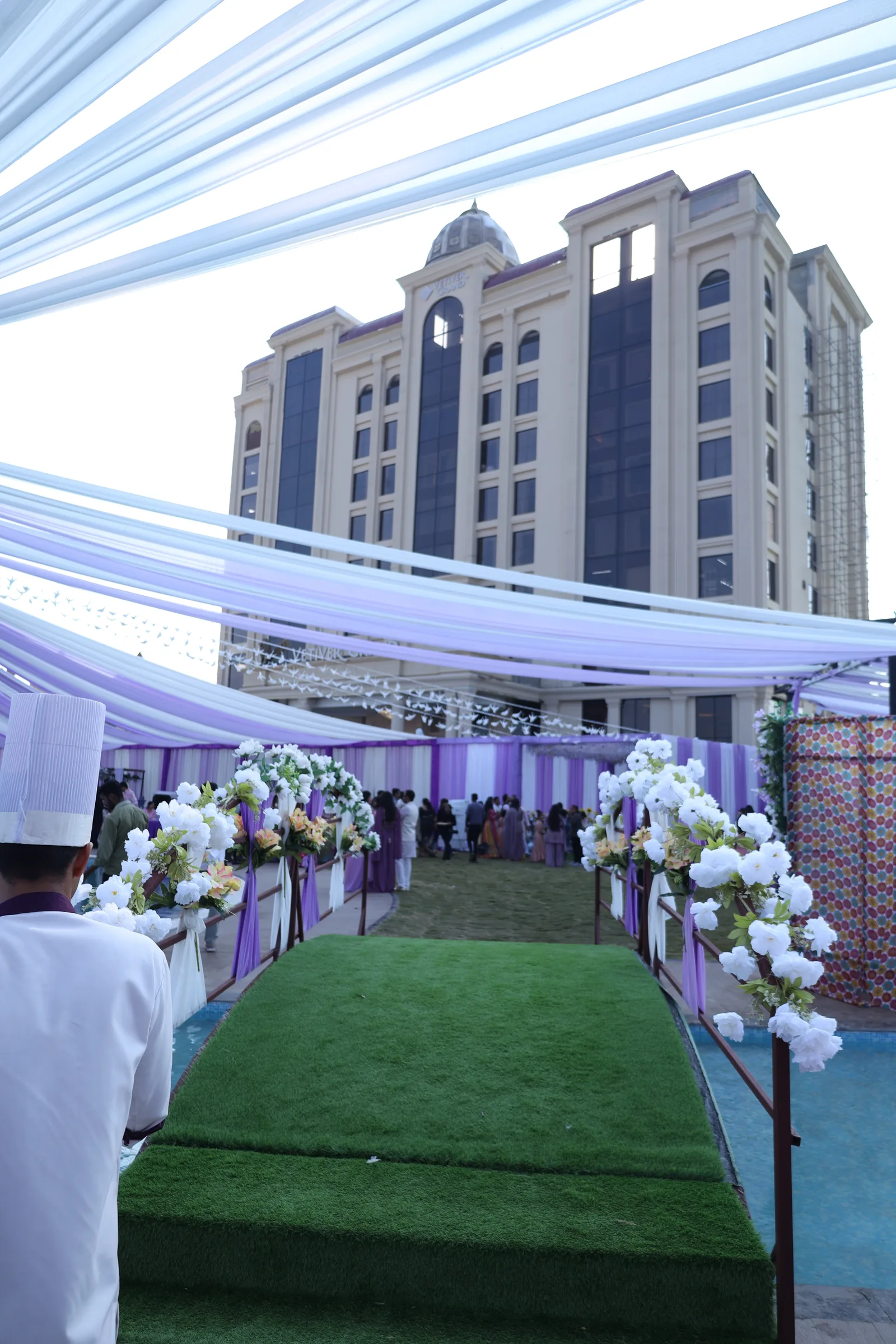
The JournalWeddings
Mehndi and Sangeet Night: How to Plan Both Well
The mehndi ceremony is the daytime function where henna goes on the bride's hands and feet, and usually on the groom and a good share of the guests. The sangeet ceremony is the evening of family performances, songs and open dancing. Most families hold them a day or two before the wedding, on separate days or back to back on one. Plan the mehndi around the artist's hours and the daylight. Plan the sangeet around the stage, the dance floor and the 10 PM sound rule.
That rule decides more about where you hold the sangeet than the decor ever will, and most planning guides never mention it. This one works through it, along with the timings, the space arithmetic, a same-day running order and the handful of decisions that are cheaper to make early.
Mehndi vs sangeet at a glance
| Mehndi | Sangeet | |
|---|---|---|
| Purpose | Henna for the bride, family and guests | Performances, songs and open dancing |
| Time of day | Late morning to late afternoon | Evening into night |
| Typical length | 3 to 6 hours (the bride's sitting sets it) | 4 to 5 hours |
| Who attends | Closer family and friends, usually | The wider guest list, often everyone |
| Space needs | Low seating, shade, good light, a quiet corner for the bride | A stage, a real dance floor, sound and lighting |
| Sound | Background music, live dholak or a playlist | Amplified, and subject to the 10 PM rule outdoors |
The short version: the mehndi is a sitting-down function and the sangeet is a standing-up one. They want different rooms, or the same room dressed very differently.
Planning the mehndi ceremony
How long the bride's mehndi really takes
A full bridal application, hands to elbows and feet to ankles, commonly takes four to six hours. Simpler designs take one to two. Ask your artist for her own estimate, because detail and coverage swing it widely. The paste dries and cracks in about 15 to 20 minutes, but the stain starts orange and keeps darkening for 24 to 72 hours.
That stain curve is the reason to hold the mehndi one or two days before the wedding rather than on the morning. Done the day before, the colour peaks for the pheras.
If the family wants daylight photographs of the finished hands, count backwards from sunset. In Jabalpur that falls around 5:25 PM in late November and December, and closer to 6 PM by mid-February. A five-hour sitting that has to wrap by 4:30 PM needs the bride seated by about 11 AM. Fix the muhurat first (our list of auspicious wedding dates helps if you are still choosing), then work the mehndi day back from it. If the haldi falls in the same week, our haldi ceremony guide covers how to keep its morning clear of the mehndi.
How many mehndi artists you need
The thing that goes wrong most often at a guest mehndi is the queue. Two artists, eighty guests, and by three in the afternoon the aunts are on the stairs waiting for a palm design. The fix is one line of arithmetic:
Artists needed = (guests wanting designs × minutes per design) ÷ minutes in the window
Say 80 guests want henna, a simple palm takes about 8 minutes once you allow for the changeover, and the guest window runs three hours (180 minutes). That is 80 × 8 ÷ 180, about 3.6, so book four guest artists, plus whoever is doing the bride. Artists quote 3 to 5 minutes for a quick design. We plan on 8 because the chair never turns over at the quoted pace: someone wants to see the catalogue, someone wants both hands. Confirm the minutes with your artist and run the sum again.
Seating, shade and light
Low seating with bolsters keeps hands steady and puts the artist at the right height. Keep guests out of direct sun before about 4 PM, for the henna's sake as much as the silk's. After sunset, warm light flatters skin and stain alike, so get the daylight photographs done before the photographer's kit comes out.
The bride needs a quiet corner and a helper. With wet paste on both hands she cannot eat, hold a phone or fix a dupatta for several hours, and the pattern we see again and again is relatives drifting over to chat while the artist is mid-vine. At a hotel venue, ask for a suite with a separate living area as her room: the family sits with her in one room while the artist works in the other.
Mehndi decoration ideas
The mehndi decoration ideas that photograph best are the simple ones done generously: marigold strings in quantity, mirror-work panels, a swing for the bride, printed umbrellas overhead, floor cushions in two or three colours rather than ten. For mehndi function decoration, our one firm piece of advice is to build a single base set (a stage frame, a backdrop structure, a seating plan) that can carry into the evening. The sangeet section explains why.
One safety line every family should hear. Natural henna stains reddish-brown. So-called "black henna" commonly contains PPD, a coal-tar hair dye that the US FDA warns can cause serious skin reactions, some of them scarring. Ask your artist what is in the cone, and do a small patch test on anyone with sensitive skin.
Planning the sangeet night
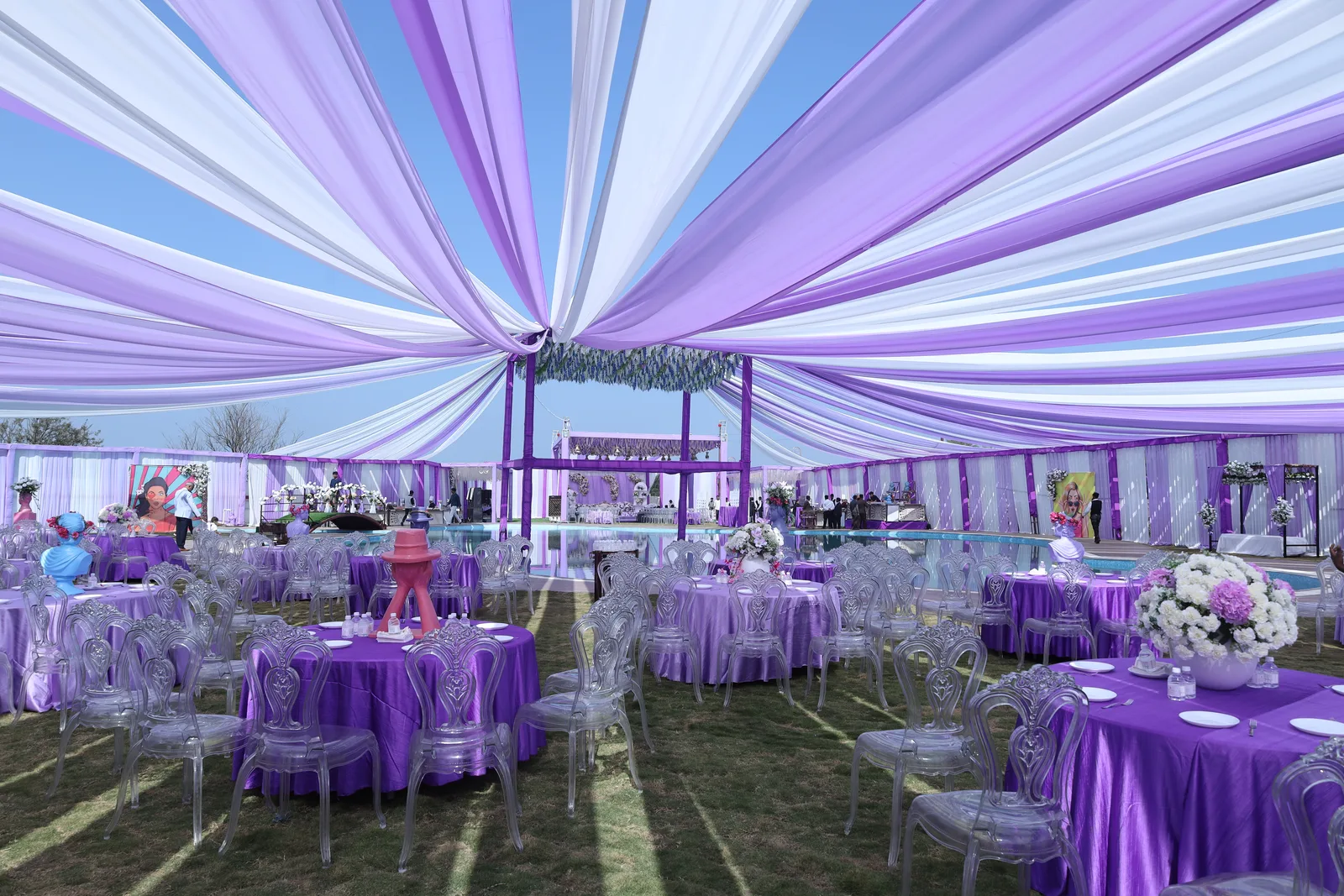
The sangeet is the most venue-dependent function of the wedding. A mehndi can happen in a courtyard. A sangeet needs a stage, sound, light and a floor people will actually dance on. Sangeets here run from close-family evenings in the smaller halls to full lawn nights with a DJ and a fireworks bridal entry. For the wider range of formats, see party and sangeet venues in Jabalpur.
Stage, dance floor and sound
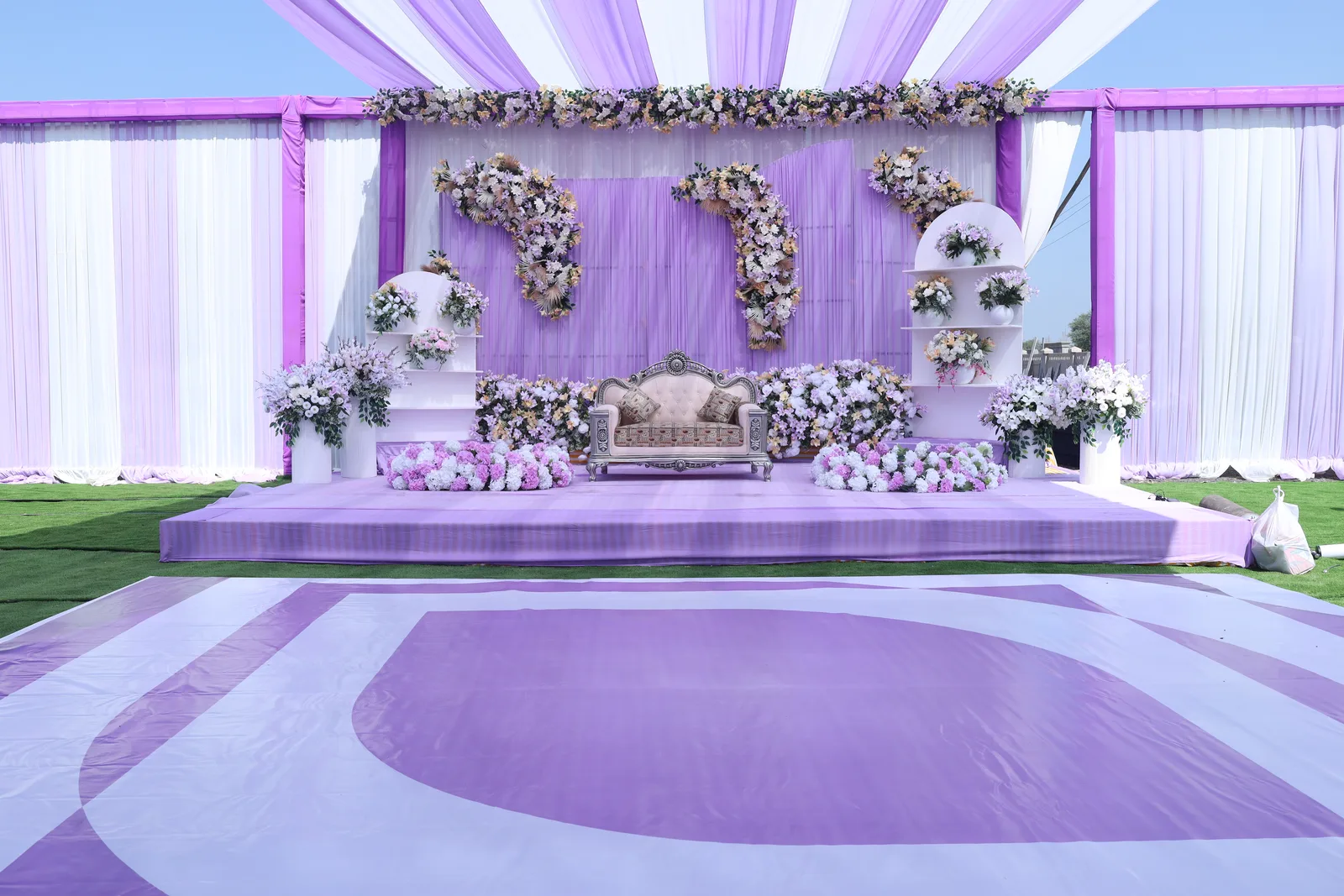
Plan the room as three zones: a performance stage visible from every seat, a dance floor sized to the peak crowd rather than the guest list, and a DJ and AV corner close to both but out of the sightline.
For the dance floor, multiply your guest count by the share dancing at once (40 to 50 percent is a common planning figure for a wedding, more with a good DJ) and allow 4 to 4.5 sq ft per dancer. A 150-guest sangeet at 50 percent needs roughly 340 sq ft, about 18 by 18 ft. Smaller than that and the floor jams. Much bigger and it looks empty for the first hour, which is exactly when you want it to look full.
Each hall and lawn at Vetiver Grand has its own audiovisual system and customisable lighting, so the sound plan can start from the room's kit rather than a blank rental list; confirm with the events team what your booking includes. See private events and celebrations for the spaces.
Choreography and running order
Keep each act to three to five minutes; longer and the back rows start talking. Group the acts by family (bride's side, groom's side, cousins, the parents' surprise number), give the anchor the order on paper, end with the couple, and open the floor straight away. The gap between the last act and the first song is where a sangeet loses its crowd.
Book a rehearsal on the actual floor the day before. Choreography learnt in a living room rarely fits a real stage, and the sound check finds the dead speaker before the guests do.
Sangeet decoration ideas
At night, lighting does most of the work. Good sangeet decoration is one strong backdrop, a coloured wash across the room, and a single entrance moment for the couple. Take the mehndi's base set, strip the daytime props, clear the floor and re-light it, and the same frame reads as a different room.
What has to physically move during the break, roughly in the order a set-up crew runs it: cushions and low seating out, swing and umbrellas down, dance floor laid and taped, DJ booth dressed and wired, backdrop swapped or re-lit, wash lights focused, sound check. Ninety minutes is comfortable. Sixty is tight and wants a crew that has done it before.
The 10 PM sound rule and how it shapes your venue choice
India's Noise Pollution (Regulation and Control) Rules, 2000, as amended, say four things that matter to a sangeet:
- A loudspeaker or public address system needs written permission from the authority before it is used at all.
- Night time runs from 10 PM to 6 AM. During it, loudspeakers, amplifiers and musical instruments may not be used "except in closed premises for communication within, like auditoria, conference rooms, community halls, banquet halls".
- A state may allow loudspeakers from 10 PM to midnight on cultural or religious festive occasions, on no more than 15 days in a calendar year, and it generally specifies those days in advance. Your date is not one of them unless it has been published as one.
- Sound-emitting firecrackers may not be burst at night.
On the night, that works out like this. On an open lawn, the performances and the loud open floor wrap by about 9:45 PM. A fireworks bridal entry happens well before 10, never as the finale. The late dance floor, if you want one, moves indoors. District and police orders can be stricter than the national rule: in February 2026, Jabalpur police told hotel operators that DJ systems were barred and loudspeakers limited to 10 PM for the board-exam period. So treat 10 PM as the outer limit outdoors, not a target, and get your permission and cut-off confirmed for your specific date.
This is the practical reason to look for a property where the lawn and the banquet halls sit side by side. At Vetiver Grand, a lawn sangeet that has to quieten down at 10 can move its late dance floor into one of five banquet halls a short walk away, with no convoy and no second venue. Our events team will confirm the cut-off for your date.
This section is general guidance, not legal advice. Rules and local orders change, so confirm the current permission and timing with the venue and the local authority for your date.
How much space a sangeet needs
We use the same method as our banquet hall sizing guide: floating or lounge spacing of 8 to 10 sq ft per guest, less the floor taken by the stage, dance floor and DJ corner. For a sangeet that deduction runs near the top of the guide's 10 to 30 percent band, so the "sangeet fit" below is the guide's floating estimate less about 30 percent.
| Venue | Floor area | Sangeet fit (est.) |
|---|---|---|
| Royal hall | 1,500 sq ft | ~105 to 135 |
| Crown hall | 1,600 sq ft | ~110 to 140 |
| Monarch hall | 1,700 sq ft | ~120 to 145 |
| Regal hall | 2,200 sq ft | ~155 to 190 |
| Imperial hall | 10,000 sq ft | ~700 to 875 |
| Garden lawn | 12,000 sq ft | ~840 to 1,050 |
| Premier lawn | 18,000 sq ft | ~1,260 to 1,575 |
Floor areas are exact; guest numbers are planning estimates. Regal is the natural room for a 150-guest sangeet; on either lawn the 10 PM rule applies. The Elite (20,000 sq ft) and Royale (35,000 sq ft) lawns scale further. A seated dinner in the same room needs more space per guest, so confirm your layout with our team.
Two worked examples, because the table hides the trade-off.
150 guests in Regal (2,200 sq ft). Dance floor 150 × 50% × 4.5 ≈ 340 sq ft. Performance stage about 250 sq ft. DJ and AV corner about 100 sq ft. That leaves roughly 1,500 sq ft, which holds 150 to 185 guests at lounge spacing but only about 100 to 125 at seated-dinner spacing. So Regal is right for a 150-guest sangeet with lounge seating and a buffet, not a full seated dinner in the same room.
450 guests in Imperial (10,000 sq ft). Dance floor 450 × 50% × 4.5 ≈ 1,000 sq ft. Stage about 500 sq ft. Buffet and live counters about 1,200 sq ft. Theatre rows for the performances at 7 to 8 sq ft a guest take 3,150 to 3,600 sq ft. Total: roughly 5,850 to 6,300 sq ft, leaving room for round tables for part of the crowd. Past about 700 to 800 guests, look at the lawns, where the 10 PM cut-off applies.
Doing both on one day: a sample timeline
Combining the two saves a day of venue, decor and guest travel. Here is a running order for a lawn sangeet, built around the 10 PM handoff:
| Time | What happens |
|---|---|
| 10:30 AM | Bride's mehndi begins in a private room |
| 1:00 PM | Guests arrive; lunch; guest mehndi artists start |
| 4:30 PM | Guest mehndi wraps; daylight photos before the ~5:25 PM sunset |
| 5:00 to 6:30 PM | Break: guests change, crew re-dresses the set and lights the stage |
| 6:30 PM | Sangeet doors open; snacks and mocktails |
| 7:00 to 8:45 PM | Performances |
| 8:45 PM | Dinner opens |
| 9:00 to 9:45 PM | Open dance floor outdoors |
| 9:45 PM | Loud segment moves indoors to a hall; late floor continues inside, per your permission |
Do not shave the break. It is the first thing a same-day plan loses when the mehndi runs long, and a re-dress, a sound check and a hundred outfit changes need every minute of it. For the shape of a multi-day celebration, see planning a destination wedding in Madhya Pradesh.
When not to combine them
The catch with a same-day plan is the bride. Either she sits for her full mehndi in the afternoon and arrives at the sangeet with fresh paste (no hand-held mic, help with eating, a careful outfit change), or she has hers done the day before. If she is performing, do not combine.
| Plan | Works well when | Trade-off |
|---|---|---|
| Separate days | Long guest list, bride is performing | One more day of venue and travel |
| Same day | Compact wedding, guests travelling in | Bride attends the sangeet with wet paste |
| Split: bride a day early | Most families who want one big night; guests get henna at the sangeet | An extra small booking for the bride's sitting |
The third option is the one we suggest to most families. The bride sits in peace, her stain deepens on schedule, and guests still get henna while the evening warms up.
Food and drinks for a long evening
A four to five hour evening needs pacing. Open snacks and mocktails at arrival. Hold the main buffet until after the performances, so the room stays facing the stage; open it mid-act and half the audience leaves for the chaat counter. Keep one live counter running into the late indoor floor, because people who dance eat again.
Catering at Vetiver Grand comes from the in-house kitchen at Kasturi, our pure-vegetarian restaurant, so there is one menu every guest can eat. Its mocktail list, Rangeen Bahar, includes a Paan Mojito, a betel-leaf take on the classic that suits the hour. Event menus are composed on enquiry, around your guest count and the hours you are running.
A one-page checklist
- Muhurat fixed, and the mehndi and sangeet dates worked back from it
- Rough guest count for each function (they are rarely the same)
- Bride's mehndi artist booked, sitting length confirmed
- Guest artist count worked out with the formula above
- Stage, dance floor and DJ corner sized against the room
- Loudspeaker permission and the cut-off for your date confirmed
- Indoor hall held for the late dance floor if the sangeet is on a lawn
- Rehearsal slot on the actual floor, the day before
- One base set, with a day look and a night lighting plan
- Food pacing agreed: snacks at arrival, buffet after performances
- A room for the bride, and rooms for the family
Ready to pencil in the dates? Bring three things: your date, a rough guest count, and whether you want mehndi and sangeet on one day or two. Use the Call or WhatsApp buttons, or see the halls and lawns, and we will suggest the right spaces, sketch a timeline, and hold the date while you decide. Rooms and suites for the family can be held with it. Still comparing properties? See how to shortlist a wedding venue in Jabalpur. Families who have not yet held the ring ceremony can start with our roka, sagai and ring ceremony guide.
FAQ
Asked at the desk
What is the difference between mehndi and sangeet? The mehndi is a daytime gathering where henna is applied to the bride's hands and feet, and often to the groom and guests, with music and food. The sangeet is an evening of family performances, songs and open dancing. Many families hold them on separate days a day or two before the wedding; some combine them, mehndi in the afternoon and sangeet at night.
Can mehndi and sangeet be held on the same day? They can, and it saves a day of venue set-up and guest travel. Plan a 60 to 90 minute break between them so guests can change and the set can be re-lit. The catch is the bride: a full bridal mehndi takes several hours and the paste needs to stay on, so many brides have theirs done the day before and keep the same-day mehndi for guests.
How long does a sangeet usually last? Plan for four to five hours: arrival and snacks, about two hours of performances, dinner, then open dancing. If any part is on an open lawn, build the timeline so amplified music outdoors ends by 10 PM and the late dance floor continues indoors.
Can music play past 10 PM at a sangeet in India? Not outdoors, as a rule. Under the Noise Pollution (Regulation and Control) Rules, 2000, loudspeakers and amplified instruments may not be used between 10 PM and 6 AM except in closed premises such as banquet halls, or on a limited number of festive days (at most 15 a year) that the state notifies in advance, and then only until midnight. Local orders can be stricter, so confirm the cut-off for your date with the venue.
How big should a sangeet dance floor be? Multiply your guest count by the share you expect dancing at once (often 40 to 50 percent at a wedding, more with a strong DJ) and allow about 4 to 4.5 sq ft per dancer. For 150 guests that is roughly 240 to 340 sq ft; at the top of that range, about an 18 by 18 ft floor. Add the stage and DJ area on top when you check whether a hall fits.
How many days before the wedding should the mehndi be? One to two days before works best for the bride. Henna starts orange and darkens over 24 to 72 hours, so a mehndi the day before or two days before puts the deepest colour on the wedding day. Guests can have quick designs at any function.