The JournalWeddings
Haldi Ceremony Guide: Rituals, Decor and Venue Tips
A haldi ceremony is the pre-wedding ritual in which family and friends apply a turmeric paste to the bride and groom, as a blessing before the wedding. Most families hold it the day before the wedding or on the wedding morning; the timing varies by community. The ritual itself runs an hour or two, plus the wash-off. Most guides stop at the meaning and the marigolds. This one also covers what we deal with when a family hosts a haldi at a venue: which space, how much daylight a Jabalpur December actually gives you, where the couple rinses, and how many hours to leave before the evening function.
What is a haldi ceremony, and why is it done?
At its simplest, a haldi is a family taking turns to smear turmeric paste on the couple's face, arms, hands and feet. In many families the elders go first, the mother and grandmothers, before cousins and friends pile in. By the end nobody is clean and nobody minds, which is why it tends to be the most relaxed function of the whole wedding.
The meaning is a matter of belief. Most families see the paste as a blessing and a purification before the couple's new life; the Banglapedia entry on the Bengali gaye halud adds that it is meant to protect the couple from misfortune and the evil eye. There is no fixed recipe. Turmeric is the constant, and the rest is some mix of gram flour (besan), oil (mustard oil in many Punjabi homes), sandalwood, rose water, milk or curd, whatever the family has always used.
The same ritual, different names
You will hear several names for what is, broadly, the same morning:
- Gaye holud (also gaye halud) in Bengali families; Hindu Bengali families may also call it gatra haridra or adhivas.
- Maiyan or vatna in Punjabi families, where the paste itself is the vatna.
- Nalugu in Telugu weddings, followed on the wedding day by the mangala snanam, the ritual bath.
- Pithi, as Gujarati families often call it.
Ask the elders in both families which version you are following. It decides the timing, and in some traditions it decides whether the haldi is one morning or a run of several days.
When to hold the haldi, and how long it takes
There is no universal day. Punjabi maiyan usually falls a day or two before the wedding. A Bengali gaye holud can begin three, five or seven days earlier. In Telugu weddings the turmeric leads straight into the wedding-day bath. Most of the families we plan with end up choosing between two slots: the day before, or the wedding morning.
The day before is the calmer choice. The couple has a full evening for the colour to soften, and nobody is racing the makeup artist. The wedding morning keeps the guest days shorter but compresses everything after it. If you go that way, leave at least two to three hours between the rinse and the start of hair and makeup.
The order of haldi and mehndi is not fixed either. Some families do haldi first, others mehndi; follow your own family's lead, not a blog's. (If the engagement itself is still ahead of you, our roka, sagai and ring ceremony guide covers that evening.)
Morning beats evening, and Jabalpur's light explains why
For most weddings, hold the haldi in the morning: better light for photographs, an afternoon to wash the turmeric out, and a free evening for the next function. The clock is tighter than families expect, because Jabalpur's peak wedding months fall in winter:
| Date | Sunrise (around) | Sunset (around) |
|---|---|---|
| 1 December | 6:35 am | 5:25 pm |
| 1 January | 6:50 am | 5:35 pm |
| 1 February | 6:50 am | 5:55 pm |
Calculated for Jabalpur with standard solar-position formulas and rounded to the nearest five minutes.
An "afternoon haldi" on an open lawn in December sounds relaxed. Start at 2 pm and the ritual, the rinse and the family photographs are all chasing a sun that is gone by half past five. Our working rule for an outdoor haldi is to start by 10:30 to 11:00 am. If you are still fixing the wedding date itself, start with our list of auspicious wedding dates for 2026 and 2027; the first muhurats of this season fall in late November.
What you need for a haldi: the checklist
Most of what goes wrong at a haldi is something nobody was asked to bring. Put a name against every line.
| Item | Why it matters | Who usually arranges |
|---|---|---|
| Paste, bowls (an urli works well) | Enough for every relative to take a turn | Family |
| Low seat or patri for the couple | Keeps paste off upholstered furniture | Decorator |
| Old or washable outfits | Turmeric rarely comes fully out | Couple and family |
| Floor sheets under the splash zone | Protects floors and carpets | Decorator, confirm with venue |
| Towels and wet wipes | Hands get yellow long before lunch | Family |
| Slip mats near the rinse point | Wet turmeric on tile is slippery | Venue (ask) |
| Shade or a canopy | Midday sun is hard on the couple and on photos | Decorator |
| Drinking water | A long morning outdoors | Venue or caterer |
| Marigolds and petals | The look, and petals for the shower | Decorator |
| Music (dhol or speakers) | Sets the mood, and needs power | Family or DJ |
| A change of clothes, and a bag for the stained ones | For after the rinse, and so nothing yellow touches clean luggage | Couple |
One more line, for anyone with sensitive skin. Turmeric's pigment, curcumin, is a documented contact allergen (Journal of Clinical and Aesthetic Dermatology, 2015), so try a dab of the paste on the inner arm a day or two before. It takes a minute.
Haldi decoration ideas that photograph well
The haldi decoration ideas that rank online are mostly built for a living room. At venue scale, the backdrop colour, the couple's seat and the direction of the light decide the photographs. The props are secondary.
Marigold, yellow and one contrast colour
Marigold curtains are the classic for good reason: they read as haldi in a single frame. But a backdrop that is all yellow, behind a couple dressed in yellow and covered in yellow paste, flattens out on camera. Add one contrast colour and commit to it: deep green foliage, pink, or white. It gives the photographer edges to work with.
A swing or low seat for the couple
A flower-wrapped jhoola is the favourite haldi function decoration, and it photographs beautifully. A low seat or a patri is the practical cousin. Either way, keep the couple low and the seat washable or covered, so relatives can reach them without leaning over furniture that will never be the same colour again.
Light and backdrop direction
Seat the couple in open shade, under a canopy, facing the light. Do not build the backdrop so that the late-morning sun sits behind them, or every photograph becomes a silhouette with a yellow halo. Near the seat, use fabric you are happy never to reuse, and keep any artificial flowers you want back well outside the splash zone.

Hosting a haldi at a venue: the logistics nobody mentions
When a family books a haldi with us, the first conversation is usually about decor. The last one, often in the final week, is about where the couple will wash off. It should be the other way round. The decisions below are what make the morning feel easy.
Lawn or hall?
| Factor | Open lawn | Banquet hall |
|---|---|---|
| Light | Natural daylight, best photos | Even, controlled lighting |
| Splash | Grass forgives a lot | Floors need full cover |
| Weather | Needs a fallback space | Unaffected |
| Feel | Open, festive, room for dhol | Private and contained |
Then size it properly. A haldi is usually the closest family, not the full guest list, and people stand, dance and drift around the couple rather than sit at tables. So plan on floating capacity, roughly 8 to 10 sq ft per guest, minus 10 to 30% for the couple's platform, the splash zone and a food counter. Our banquet-hall sizing guide walks through the full method.
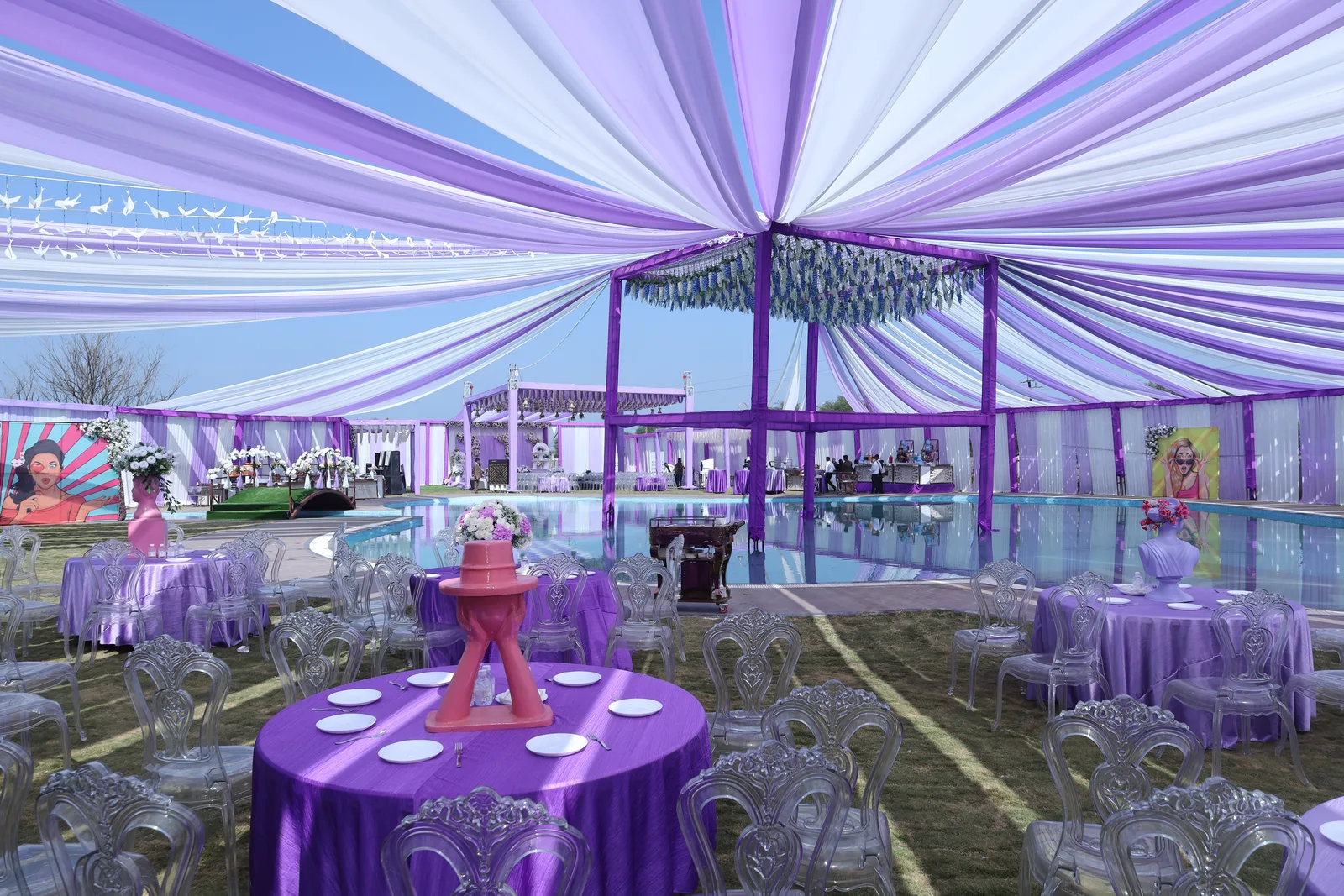
To make the numbers concrete: at Vetiver Grand in Jabalpur, a 120-person family haldi sits comfortably in the 1,500 sq ft Royal hall (about 150 to 190 floating before deductions), and the 1,600 sq ft Crown is close behind. A larger one with dhol and dancing fits the 2,200 sq ft Regal, and a full open-air haldi goes to the 12,000 sq ft Garden lawn, with a hall kept as the weather fallback. A set-up on the lawn beside the pool is possible on request, subject to availability. With 90 rooms and suites in the same building, the couple can rinse off in their own room rather than a shared washroom. The halls and lawns are on our wedding venues in Jabalpur page.
Protecting floors, fabric and furniture
Define a haldi zone and protect everything inside it: sheets under the splash area, covered seating, nothing precious within arm's reach of the paste. Then put five questions to the venue before you sign, and get the answers in writing:
- Is turmeric allowed in this particular space?
- Who supplies the floor covers, the venue or the decorator?
- Is there a cleaning charge, and how much?
- How far is the nearest bathroom from the haldi spot?
- Can a room be held for the couple to rinse and change?
Nobody enjoys asking these. They save an argument the next morning.
Where the couple rinses and changes
The cleanest answer is a room on site, close to the haldi space. Hold one each for the bride and the groom, so neither is queueing for a shared washroom in a towel. If the haldi is in the morning, ask about early check-in; at Vetiver Grand it is on request, subject to the day's arrivals, and every one of our rooms and suites has an attached bathroom.
Plan for the hair. Turmeric in hair takes far longer to wash out than skin, so budget the time and pack old towels you will happily throw away.
From haldi to the next function
If the haldi and an evening function share a day, work backwards from the evening. These are planning estimates, not fixed rules:
| Step | Plan for | Example clock |
|---|---|---|
| Haldi ritual | 60 to 90 minutes | 11:30 am to 1:00 pm |
| Couple's rinse | 30 to 45 minutes | Until about 1:45 pm |
| Rest and lunch | About 60 minutes | Until about 2:45 pm |
| Hair and makeup | 2 to 3 hours | Until about 5:45 pm |
A haldi that ends by 1 pm leaves a realistic 6 to 7 pm start for the mehndi or sangeet. Two rules hold every time. Never put the haldi and the evening function in the same space on the same day; a venue with several halls and lawns lets the evening space be dressed while the haldi runs elsewhere. And if the sangeet runs late, the amplified part belongs indoors after 10 pm, which is when "night time" begins under India's Noise Pollution Rules, 2000. Our mehndi and sangeet planning guide covers the sound rule properly. For how the days fit together across a full wedding, see a three-day wedding plan on one estate.
Food for a daytime haldi
Half the guests will have turmeric on their hands by 11 am. That is the constraint, and it rules out anything that needs a fork and both hands. What works is food you can hold by one end: skewered, wrapped or cup-served snacks, plus a mocktail counter running through the morning. Save the proper sit-down lunch for after the rinse, when the couple can actually eat.
Many families also want a fully vegetarian kitchen for pre-wedding rituals, which makes the menu simpler, not harder. At Vetiver Grand, event catering comes from Kasturi, our pure-vegetarian kitchen on the ground floor. For the style, this is the kitchen that makes the Paan Mojito, a betel-leaf mocktail, the Kasturi Kathi Roll (spiced cottage cheese in roomali roti) and the pakoras on its Indian light snacks list, all of them manageable with one clean hand. The haldi menu itself is planned with the team for your morning and your guest count.
How to remove haldi stains from skin and clothes
Skin. Rinse with plain water first, then use a gentle cleanser. Do not scrub hard; the yellow tint usually fades over a day or two on its own, which is one more argument for the day-before slot.
Clothes. The method with the best chance of success, following Ariel India's care guidance:
- Scrape off the excess paste. Do not rub it in.
- Blot the stain with cold water.
- Soak in detergent, then wash at the warmest temperature the care label allows.
- Dry whites in direct sunlight, which helps fade what is left.
- Keep coloured and delicate fabrics out of strong sun and away from bleach.
Two things surprise people. Plain soap is often not enough on its own. And a stain can flash orange or red when soap hits it, then settle back to yellow as it rinses; that is the turmeric pigment reacting to alkaline soap, not a new stain. If a favourite outfit matters, do not wear it to the haldi.
Kasturi manjal and everyday turmeric
Families sometimes ask for "kasturi haldi" for the paste. It is a different plant. Kasturi manjal, the Tamil (and Malayalam) name, is Curcuma aromatica, often called wild turmeric. The turmeric in your kitchen is Curcuma longa. Kew's Plants of the World Online lists them as separate species in the same genus. Kasturi manjal is used across South Asia mainly as a cosmetic herbal, and only in limited quantities as a food colour. If an elder's recipe names it, buy that specifically rather than substituting the kitchen spice.
Holding the haldi with us? Send our wedding desk your date and a rough guest count from the wedding venues page, by WhatsApp or a call, and we will suggest the space and the start time that fit. If you are still comparing venues, start with how to shortlist a wedding venue in Jabalpur.
FAQ
Asked at the desk
What is a haldi ceremony and why is it done? A pre-wedding ritual in which family and friends apply a turmeric paste to the bride and groom. Families see it as a blessing and a cleansing before the wedding, and many believe it keeps away the evil eye. The paste and the customs vary by community.
Is the haldi held on the wedding day or the day before? Most often the day before, though many families hold it on the wedding morning and some traditions begin days earlier. If the haldi falls on the wedding morning, leave at least two to three hours between the rinse and the start of hair and makeup.
Should a haldi be in the morning or the evening? Morning, for most weddings. Daylight is best for photos, the couple has time to wash the turmeric out, and the evening stays free. In Jabalpur's winter wedding season the sun sets around 5:30 pm, so a lawn haldi is best started by late morning.
Can the bride's and groom's haldi be held at the same venue? They can. Traditionally each family holds its own at home, but many couples now host both at one venue, either together or in two spaces at the same time. Two spaces need two rinse points, so hold a room for each.
How do you get haldi stains out of white clothes? Scrape off the paste, blot with cold water, soak in detergent and wash, then dry the garment in direct sunlight, which helps fade what is left. Plain soap is often not enough. Keep coloured and delicate fabrics out of the sun and away from bleach.