The JournalWeddings
Roka, Sagai or Ring Ceremony? An Engagement Guide
A roka is the first, small family agreement that the match is fixed, and traditionally no rings change hands. The sagai, which most families now call the engagement or ring ceremony, is the larger formal event where the couple exchange rings. A tilak is a separate rite, centred on the groom, performed by the bride's family. Names, order and size vary by region and by family, so read what follows as the common pattern rather than a rulebook.
The vocabulary is the easy part. The planning half is what families actually ring us about, so it gets most of the space here: how many people a hall seats once a ring stage is standing in it, how long the afternoon runs and when the meal has to open, what the law says about music on a lawn after 10 p.m., and how the engagement date fits around the wedding muhurat.
Roka, sagai, ring ceremony and tilak compared
The four terms overlap, and families use them loosely. In North Indian practice they usually sort out like this:
| Roka | Sagai (ring ceremony) | Tilak | |
|---|---|---|---|
| What it marks | Families accept the match | The formal engagement | Bride's family accepts the groom |
| Centred on | Both families | The couple | The groom |
| Who attends | Close family | Extended family and friends | Both families, often without the bride |
| Rings | Traditionally no | Yes, the point of it | No |
| Typical size | Small | Medium to large | Usually family-sized |
| Traditionally held | A family home | A home, now often a venue | The groom's home |
| Before the wedding | Usually the first step | Days to months ahead | Varies by community |
The sagai and the ring ceremony share a column on purpose. "Ring ceremony" is mostly the urban, English name for the ring exchange at a sagai; Pataaree and WeddingWire both treat the terms as overlapping, and so do most families we plan with. The tilak is the one that genuinely differs. The bride's family, traditionally her father or brother, applies a tilak to the groom's forehead, and in many communities the bride does not attend (Manyavar on the tilak).
Much of India has its own word for the engagement: Sakhar Puda in Marathi families, Ashirbaad in Bengali, Nichayathartham in Tamil, Gol Dhana among Gujaratis, Kurmai or Shagan in Punjabi homes (CulturalIndia keeps a longer list). The shape is similar everywhere. The rituals inside it belong to each family, and the elders will know which version yours keeps.
What happens at an engagement ceremony
Most North Indian sagai ceremonies follow a recognisable arc, in roughly this order:
- Arrival and welcome. The groom's side often arrives together, which means a quiet room fills in five minutes. Put someone from the host family at the door, not on the stage.
- A short puja. Many Hindu families open with a brief Ganesh puja led by the family priest (Aza on the sagai). Allow 20 to 30 minutes.
- Introductions, milni or tilak. In some families the fathers and senior relatives garland each other in a milni. Others fold a tilak in here.
- The ring exchange. Two minutes. The build-up takes longer.
- Blessings and shagun. Elders bless the couple, and trays travel between the two sides, commonly carrying sweets, fruit, dry fruit, clothes and jewellery (Utsavpedia on the sagai).
- The wedding date. In many families the date is confirmed, or announced, at the sagai (a community guide to the engagement).
- The meal and photographs.
From the venue side, the step that overruns is almost never the puja. It is the stage photographs after the rings, when every branch of both families wants its own frame with the couple. If the meal waits for the photographs to finish, the elders sit hungry for an hour. Our advice to any host family: open the food while the photo queue is still running, and say so before the day, because someone will ask why lunch has started without them.
What is different at a roka
A roka is smaller and quieter. The name is usually explained as coming from the Hindi rokna, to stop, meaning the search for a match has ended (Manyavar on the roka). You will often see blessings or a short puja, a tilak, the chunni draped over the bride in Punjabi custom, and an exchange of gifts, sweets, dry fruit and clothes. Rings are traditionally not part of it (WedMeGood), though some couples now add them, and some families fold the roka and the sagai into a single function.
How long before the wedding to hold it
There is no one correct gap. Across communities, the engagement can fall anywhere from a year before the wedding to a day or two before it; some Punjabi and Muslim engagements take place the day before (CulturalIndia). Any guide that gives you a fixed number of months is describing one family's preference.
What helps is working backwards from the wedding muhurat, the date with the least room to move:
- Lock the wedding muhurat and the venue first. The most wanted winter and May dates go first, so book the venue as early as the families can agree (the auspicious wedding dates guide lists every 2026 and 2027 muhurat).
- Then fix the engagement inside the window your families prefer. It usually needs to come before the wedding invitations are printed, since the date is often announced at it.
- Check the calendar gaps. From mid-July to early November there are no vivah muhurats (Chaturmas). If the wedding is in late November or December 2027, the months just before it fall in that stretch. Whether your family will hold a sagai then is a question for your priest; many families check the panchang first, and some end up looking at spring or early summer instead.
Confirm the engagement date and time with your family priest. We can tell you whether a hall is free on a given day; the muhurat is theirs to read.
How many guests, and what size of room
The working rule, the same one behind our full sizing math: a seated lunch or dinner at round tables needs about 12 to 15 sq ft per guest; ceremony rows need only 7 to 8; a standing, floating reception needs 8 to 10. A ring-ceremony stage takes 200 to 600 sq ft on its own, and together with the buffet counters it trims a hall's usable capacity by 10 to 30%.
Size for the meal rather than the ceremony. People sit closer in rows for the rings than they do at tables for lunch, so the seated meal count is the number that chooses the room.
| Hall | Floor area | Seated, ring stage in (derived) | Floating (est.) |
|---|---|---|---|
| Royal | 1,500 sq ft | about 70 to 110 | about 150 to 190 |
| Crown | 1,600 sq ft | about 75 to 120 | about 160 to 200 |
| Monarch | 1,700 sq ft | about 80 to 125 | about 170 to 210 |
| Regal | 2,200 sq ft | about 100 to 165 | about 220 to 275 |
| Imperial | 10,000 sq ft | about 450 to 750 | about 1,000 to 1,250 |
The seated column takes our standard seated estimate for each hall and subtracts 10 to 30% for a stage and buffet. The floating column is the standard estimate before any stage. All figures are planning estimates; the events team confirms the count for your actual layout.
A roka at 30 to 60 people
A roka is often 30 to 60 close family, fewer than even the smallest hall seats. That works if the room is dressed for the number: fewer tables, a decorated seat for the couple instead of a full stage, the buffet pulled in closer. A room set for 110 with 40 people in it feels like a waiting hall. Many families still prefer a home for a roka, which is a perfectly good answer; at a venue, ask what small-room options exist for that size.
A sagai at 100 to 250
Most engagements land here, and format matters most. Up to roughly 120 seated with a stage, Royal, Crown or Monarch will do it. Between about 120 and 165 seated, Regal is the fit. Above that you have two options: switch to a floating format, where Regal holds more people standing, or move to the Imperial and dress it down to the size of your list. Decide seated or floating first, because that one choice moves the number more than anything else.
At Vetiver Grand in Jabalpur, the four smaller halls (1,500 to 2,200 sq ft) cover exactly this range, with catering from Kasturi's pure-vegetarian kitchen and 90 keys on the property for family who travel in. Ask the events desk for a layout with your stage drawn in; it is the quickest way to find out whether your list fits the room you like.
A sample running order
Two versions that add up, each about four hours including buffers.
Daytime engagement with lunch (about 4 hours)
| Time | What happens | Planning note |
|---|---|---|
| 11:30 | Arrivals, welcome drink | 30 minutes; covers late cars |
| 12:00 | Puja | 20 to 30 minutes |
| 12:30 | Introductions, milni or tilak | Keep it to 15 minutes |
| 12:45 | Ring exchange | Couple on stage, families either side |
| 13:00 | Blessings, shagun trays, stage photos | Photo queue starts |
| 13:30 | Lunch opens | No later than 45 minutes after the rings |
| 15:00 | Family photos, farewells | |
| 15:30 | Close |
Evening ring ceremony with dinner (about 4 hours)
| Time | What happens | Planning note |
|---|---|---|
| 18:00 | Arrivals, welcome drink | 30 minutes of buffer |
| 18:30 | Puja | 20 to 30 minutes |
| 19:00 | Introductions, milni or tilak | |
| 19:15 | Ring exchange | Before dinner, while the room is full |
| 19:30 | Blessings, shagun, stage photos | |
| 20:00 | Dinner opens | Music and dancing alongside |
| 21:30 | Last photos, farewells | Outdoor music wraps up |
| 22:00 | Close |
The 10 p.m. line is set by law. Under Rule 5 of the Noise Pollution (Regulation and Control) Rules, 2000, a loudspeaker or public address system needs written permission and may not be used between 10:00 p.m. and 6:00 a.m., except in closed premises such as auditoria, conference rooms, community halls and banquet halls (CPCB, the official rules). States may extend it to midnight on a limited number of festive days a year. So if any part of the evening is on a lawn, finish outdoor amplified music by 10 p.m., hold the rings and any dance set early, and move the music indoors if the party runs on. A banquet hall is a listed exception, which is the practical reason an evening ring ceremony with a late dinner usually belongs inside. Our mehndi and sangeet guide works through the rule for a full dance night.
Engagement and ring ceremony decoration ideas
Stage and backdrop
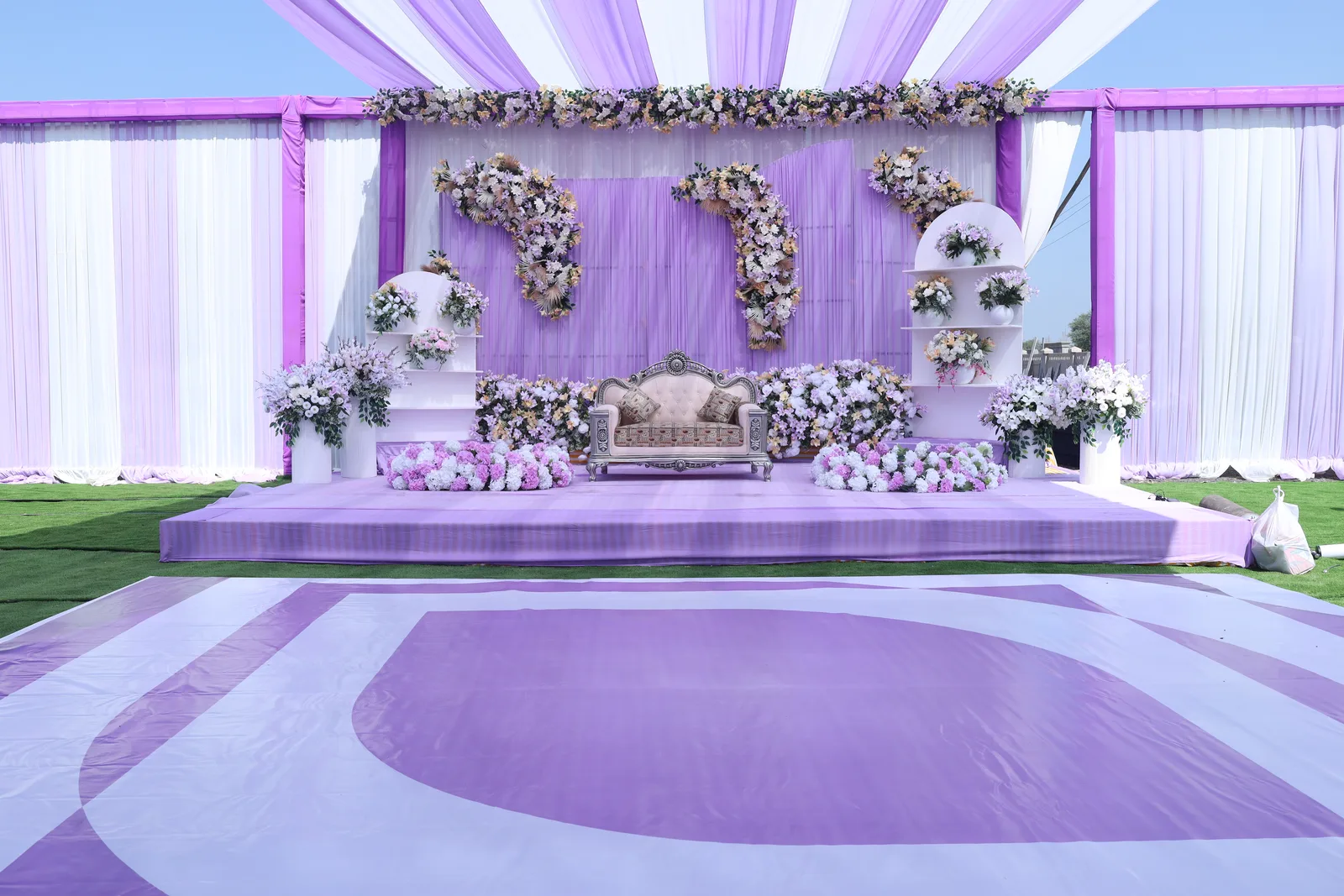
Size the stage to the room before you choose the design. In a 1,500 sq ft hall, a 200 sq ft stage leaves space for tables; a 600 sq ft stage turns lunch into a standing event. A raised platform, a floral or fabric backdrop and a loveseat for the couple is the classic engagement decoration, and it photographs well because the backdrop does the work. Leave room for both sets of parents beside the couple during the rings. That is the photograph families frame.
The ring tray and the entry moment
Decide who carries the rings, and who holds the tray, before the day. Most small delays at a ring ceremony are someone looking for a box. A decorated tray, kept with one named person, goes onto the stage just before the exchange. If the couple make an entry, keep it short and walk it through once with whoever is cueing the music; a long entry eats into the meal.
Lighting for photos
The decoration will be seen far more in photographs than in the room, and the photographs depend on the light more than on the flowers. Ask to see the stage lit the way it will be on the day, and agree with your photographer where the light falls for the exchange and for the family portraits. Our halls have audiovisual systems and customisable lighting; the question to settle early is whether the stage is lit for the camera or for the room, because the two are not always the same.
Menu ideas for an engagement lunch or dinner
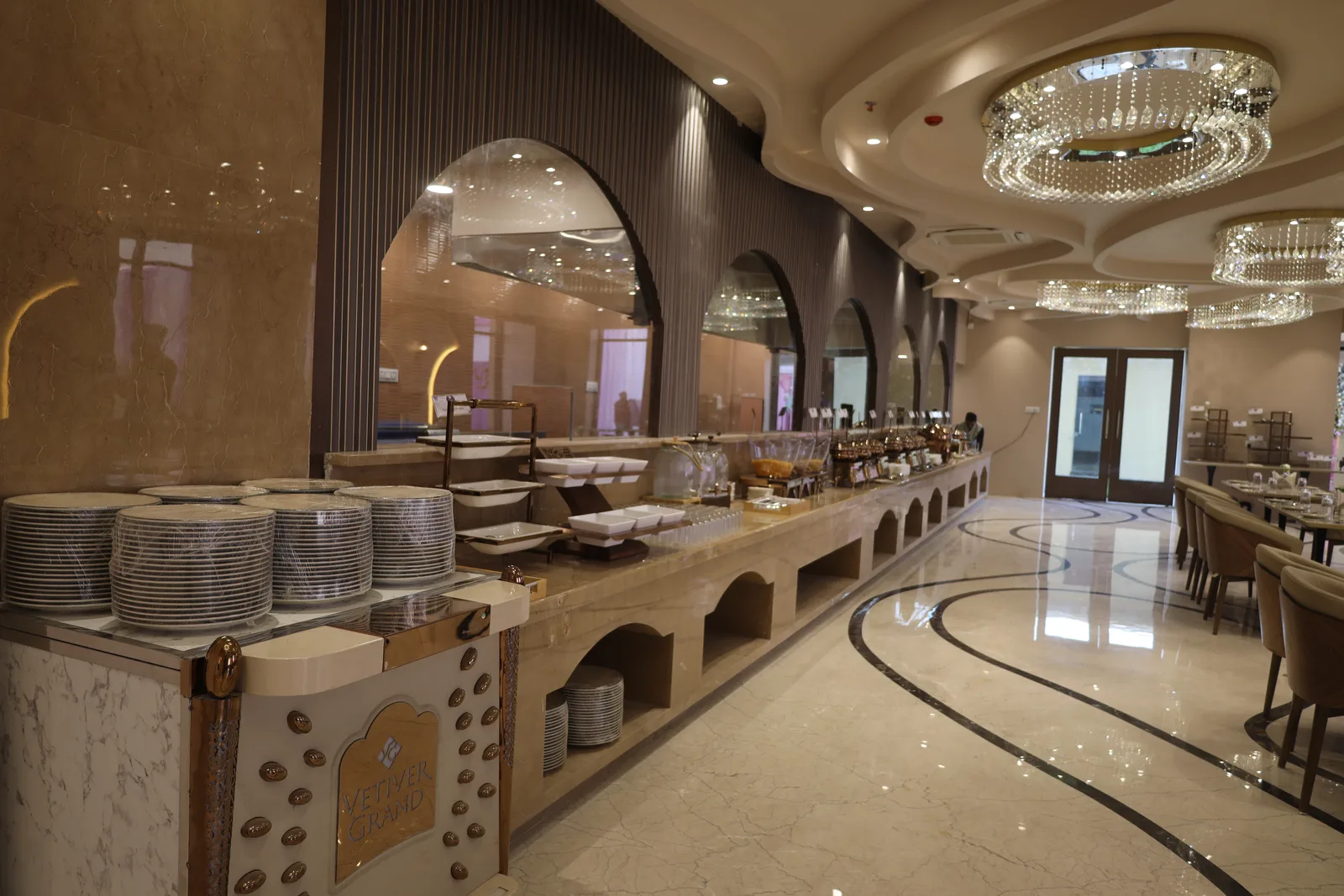
An engagement is often the first time both families sit down to eat together in numbers, with grandparents on both sides. A pure-vegetarian menu removes the separate-counter question entirely: everyone eats from the same buffet, and nobody has to ask what is in what. That is the case for keeping the engagement meal vegetarian even if the wedding menu goes another way.
A menu built from dishes on the card at Kasturi, our ground-floor pure-vegetarian restaurant, might open with the betel-leaf Paan Mojito, the most distinctive mocktail on the card, as the welcome drink, then a Veg Kebab Platter from the tandoor with mint chutney, passed around while the photographs run. For the mains, Paneer Lababdar in a smooth tomato gravy, Malai Kofta, and the VG Dal Makhani, black lentils slow-cooked overnight, with VG Classic Biryani and raita alongside. Hot Gulab Jamun to finish.
At lunch, keep the starters light and get the mains out promptly; people have travelled. At dinner, let the starters circulate during the photo queue, which keeps the room patient. These are ideas from the restaurant menu. Kasturi's kitchen builds the actual event menu with you, so bring your list of must-haves and the elders' preferences to that conversation. There is more on the kitchen in inside Kasturi.
Out-of-town family: rooms and the morning after
Some of both sides will have travelled. Vetiver Grand is about 15 km from the city centre and about 27 km from Dumna Airport: an easy drive in and out, but not one you want a grandmother making off a morning flight with a function at noon.
Two things settle the travel. The first is a small room block. The property has 90 keys, 85 rooms and 5 suites on floors two to eight of a nine-floor building, from 250 sq ft twin-bedded rooms that suit cousins sharing to the 600 sq ft Suite Room Pool Facing, whose separate living room can double as a dressing room for the couple before the ceremony; the rooms and suites page lists the types. The second is breakfast the next morning, which Kasturi serves from 07:00 to 10:30. In our experience the quiet breakfast after a function is where the two families finally talk at length, without a stage or a schedule between them.
For family arriving the morning of the engagement, ask the desk about early check-in when you book. Our guide to where to stay in Jabalpur covers the rest of the city if part of the family prefers to stay elsewhere.
Questions to ask any engagement venue
Whichever venue you are considering, these questions get real answers quickly:
- Is the capacity you quoted seated or floating, and is it with the ring stage in the room or without?
- Can the ceremony layout be reset for the meal in the same room, or do we need a second space?
- Can two halls be booked for one function, and how many other events will be running on our date?
- If any part of the evening is outdoors, where does the music have to stop at 10 p.m.?
- Is the catering in-house, and when do we sit down to compose the menu?
- Is early check-in possible for family arriving the morning of the function?
- Who on your team handles the ring tray, the couple's entry and the stage lighting on the day?
- Can you send a floor plan with our stage, buffet and table count drawn in?
For the wider shortlist, our guide on how to shortlist a wedding venue in Jabalpur goes through halls against lawns. If the evening should carry on afterwards, the rooftop at Vetiver Grand holds the infinity pool and a separate bar; pool and party bookings there are on request, and private parties are on order, so raise it when you book. Party venues in Jabalpur covers the options.
Planning a roka or sagai in Jabalpur
If you are planning an engagement at Vetiver Grand, WhatsApp the events desk (the number is on our private events and celebrations page) with three things: the date, the approximate guest count, and whether it is a lunch or a dinner. That is enough for us to suggest a hall and send a layout. If the wedding follows, the same team can hold that date too; see wedding venues at Vetiver Grand. And if the haldi and the mehndi fall in the same week, our haldi ceremony guide and our guide to planning a mehndi and sangeet pick up where this one stops.
FAQ
Asked at the desk
What is the difference between roka and engagement? A roka is the small family agreement that the match is fixed, and traditionally no rings are exchanged. The engagement, also called the sagai or ring ceremony, is the larger formal event, usually held later, where the couple exchange rings. Many families now hold both, and some combine them into one function.
Is sagai the same as the ring ceremony? In most North Indian families it effectively is: "ring ceremony" is the common English name for the ring exchange at the sagai, and many families use sagai, engagement and ring ceremony interchangeably. Some communities keep a separate roka or tilak before it.
Who pays for the engagement ceremony? It depends on the community and on the two families. In some families one side hosts by custom; many couples and families now share the cost. There is no single rule, so settle it between the families before anyone books a venue.
How many guests usually attend an engagement? Most rokas are small, often 30 to 60 close family, while a sagai commonly runs 100 to 250 guests. Size the room to the seated meal count with the stage in place: about 12 to 15 sq ft per seated guest, plus 200 to 600 sq ft for the stage.
How long does an engagement ceremony last? Plan about four hours from first arrivals to the last family photo: arrivals and puja, the ring exchange, blessings and gifts, then the meal. Build a 20 to 30 minute buffer into that for late arrivals before the puja and for the photo queue after the rings.
Can the engagement and the wedding be at the same venue? They can, and it helps: by the wedding, both families already know the halls, the kitchen and the rooms. At Vetiver Grand the smaller halls suit the sagai, and the Imperial hall and the lawns carry the wedding.